





















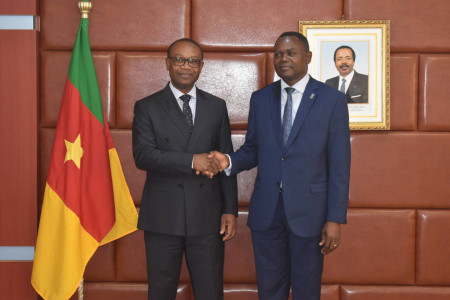
(Business in Cameroon) – Cameroon has opened a new front in its drive to strengthen the national economy, following two high‑level meetings on 9 December 2025 focused on women’s economic empowerment and expanded international cooperation for small and medium‑sized enterprises. The Minister of Small and Medium‑Sized Enterprises, Social Economy and Handicrafts (MINPMEESA), Achille Bassilekin III, held separate sessions in Yaounde with the UNDP Resident Representative, Mathieu Ciowela, and the Brazilian Ambassador to Cameroon, Patricia Maria Oliveira Lima.
The discussions set out coordinated actions to expand women’s entrepreneurship, reinforce SME capacity and accelerate agro-industrial transformation. The engagements mark a shift towards partnerships that place women-led enterprises and rural production chains at the centre of national economic development.
The UNDP consultation focused on the agency’s global gender equality strategy for 2026-2029, which identifies gender as one of three core catalysts of its programme. Ciowela outlined the planning process and gathered the Ministry’s input on how to integrate gender considerations into locally driven enterprise development.
The talks also revisited the ongoing collaboration between MINPMEESA and UNDP to position women’s entrepreneurship as a driver of national economic development. The ministry said it is working to improve women’s access to entrepreneurship and to strengthen their skills and leadership. It added that it supports innovative projects to internationalise women‑led businesses and assists women in underserved regions to ensure equal access to economic resources.
MINPMEESA revealed that initiatives such as SheTrades, Cassava, and Women in AfCFTA are part of this effort, designed to help women‑owned enterprises integrate into regional and global markets. Both institutions emphasised that these programmes aim to reinforce women’s participation in productive sectors and expand their contribution to the national economy.
In a separate audience, Minister Bassilekin III and Ambassador Patricia Maria Oliveira Lima examined ways to deepen cooperation between Cameroon and Brazil in the SME, social economy and handicrafts sectors. The discussions took place against a backdrop of longstanding collaboration, particularly through the Brazilian Agency for Cooperation (ABC) and SEBRAE, an institution specialising in support for micro and small enterprises.
The two parties reviewed potential areas for strengthened partnership in the coming year, including agro‑industry, access to equipment and the modernisation of business incubation systems. According to the Brazilian ambassador, the objective is to identify domains where strong cooperation frameworks can be established to support economic actors. She indicated that both countries are considering the development of pilot projects in production basins such as cocoa, coffee, cassava and selected handicraft sectors. These pilots would test models inspired by Brazilian experience but adapted to local realities, to increase agro‑industrial transformation.
The cooperation seeks to reinforce Cameroon’s productive capacity by drawing on Brazil’s technical expertise in value‑chain development, enterprise support and rural‑sector innovation. By focusing on agro‑industry and handicrafts, the partnership targets sectors with significant potential for job creation, export growth and local value addition.
Mercy Fosoh

