

















- (Business in Cameroon) – Cameroon wins 22 of the 86 new aggregated associate-professor positions, representing 25.58% of all admitted candidates.
- Cameroonian candidates rank in five of the six disciplinary sections, including top positions in Private Law and Political Science.
- The 2025 results strengthen Cameroon’s position as a leading academic hub in francophone Africa.
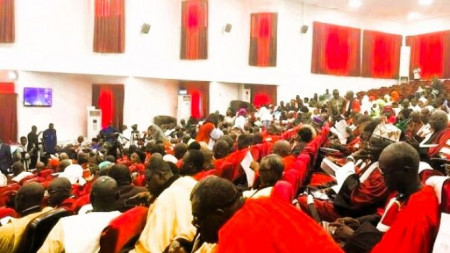
Cameroon dominated the 22nd session of the CAMES Aggregation Competition in Legal, Political, Economic and Management Sciences (SJPEG), whose in-person examinations took place from 10 to 21 November 2025 at Cheikh Anta Diop University in Dakar, Senegal.
The country secured 22 of the 86 newly proclaimed aggregated associate professors, or 25.58% of all admitted candidates. Cameroon ranked first, ahead of Burkina Faso, which followed with 16 laureates, confirming its expanding influence in the francophone African academic space.
The African and Malagasy Council for Higher Education (CAMES) published results showing that 113 candidates from 11 francophone African countries competed across six disciplinary sections. A jury of 37 senior academics oversaw the competition.
Cameroonian candidates excelled in five of the six sections. In Economics: 8 admitted out of 35 laureates; in Private Law: 4 admitted out of 12, with Marie Duvale Kodjo Gnintedem ranking first; in Public Law: 5 admitted out of 14; in Management Sciences: 4 admitted out of 1 and in Political Science: 1 admitted out of 4, with Georges Macaire Eyenga ranking first.
No Cameroonian candidate competed in the History of Institutions section.
With more than one-quarter of all admitted candidates, Cameroon confirms the strength of its doctoral schools, research laboratories and faculties in legal, economic, political and management sciences. This 2025 cohort illustrates the ability of Cameroonian scholar-researchers to meet the stringent academic standards of the SJPEG aggregation competition, one of the most selective mechanisms within CAMES.
The results now open the way for newly admitted academics to take up their posts across higher-education institutions in Cameroon. Their arrival raises strategic issues related to training quality, university governance and scientific attractiveness.
CAMES brings together 19 member countries across West Africa, Central Africa, the Great Lakes region and the Indian Ocean. The institution oversees the harmonization and promotion of academic careers across the francophone African university system.
The aggregation competition serves as one of its central tools for academic recognition and scientific mobility by establishing a common framework for evaluating competencies and facilitating inter-university careers and cooperation.
This article was initially published in French by P.N.N
Adapted in English by Ange Jason Quenum

