


























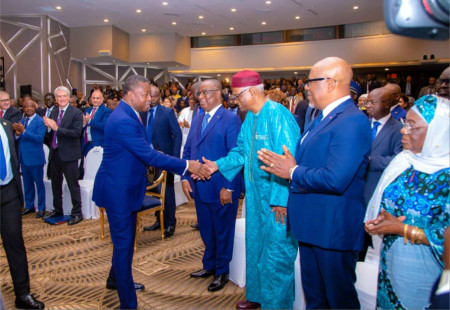
(Business in Cameroon) – Cameroon used the UK-Francophone Africa Trade and Investment Forum (WCAF IV) in Lomé, Togo, to reaffirm its commitment to import substitution as a pillar of its national development strategy. The forum, held on 12 and 13 November 2025 under the auspices of the Togolese government and the UK’s Department for Business and Trade, brought together more than 560 delegates from 442 companies.
At the event, Paul Tasong, Minister Delegate in charge of Planning at the Ministry of the Economy, Planning and Regional Development, emphasised that “as much as possible Cameroon should produce what Cameroon consumes and Cameroon should consume what Cameroon produces.” He said import substitution helps “clean our balance of payment account,” preserve national currency, and create jobs for Cameroonians through industrialisation. He also highlighted the country’s significant energy production potential as key to this strategy.
Cameroon’s import-substitution drive is embedded in its National Development Strategy (NDS30), which seeks to reduce dependence on external supplies by boosting local production. The government has launched a Three-Year Integrated Import-Substitution Plan (PIISAH) covering 2024–2026, with priority given to agro-pastoral, fisheries, livestock, fish, rice, maize, milk, and palm oil sectors. The total cost of the plan is estimated at FCFA 1,371.5 billion, with planned state funding of FCFA 248 billion in 2024, rising to FCFA 511.6 billion in 2025, and an estimated FCFA 611.4 billion in 2026.
According to the Ministry of Economy, Planning, and Regional Development, the initiative aims to ease the country’s large trade deficit, estimated at more than FCFA 1,500 billion per year. To support local industry, the 2025 Budget removed customs incentives on imported goods for which domestically produced equivalents exist, except under certain free-trade agreements or in case of shortages. In addition, certain imported animal feed supplements now benefit from a 50% reduction in their taxable import value under new customs rules.
Beyond fiscal measures, the government is mobilising science and innovation to drive production. During the 2025 Week of Science organised by the Cameroon Academy of Sciences, researchers called for greater use of technology in sectors such as agro-industry, textiles, and wood processing to support import substitution. Policy-makers also moved to strengthen institutional capacity: in August 2025, Cameroon signed performance contracts and collaboration agreements representing FCFA 13.55 billion in support of the import-substitution agenda.
Economically, government projections suggest that accelerated import substitution will lead to slower import growth and a narrowing of the current account deficit. According to the 2024 report on the national economic and financial situation, imports are expected to grow at an average of 2.8% between 2025 and 2027, compared to higher growth before, while the current account deficit is projected to fall from 3% of GDP in 2024 to 2.8% in 2025.
As the WCAF IV forum closed, Cameroonian officials and investors reiterated their shared vision of building sustainable economic bridges. For Cameroon, import substitution remains central to preserving foreign exchange, boosting domestic production, and creating jobs as part of its long-term industrial transformation.
Mercy Fosoh

