

























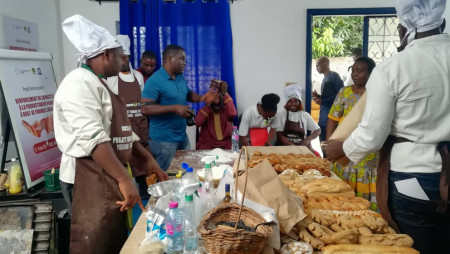
(Business in Cameroon) – A capacity-building workshop held recently in Yaounde trained artisanal bakers from the Centre region in techniques for incorporating locally-sourced flours into bread and pastry production. Organised by the Support Service for Local Development Initiatives (SAILD), the session is part of a national effort to reduce reliance on imported wheat by promoting cassava, sweet potato, and other local crops, in line with Cameroon’s import-substitution policy.
Cameroon’s import-substitution strategy, anchored in the National Development Strategy 2020‑2030 (NDS30), placed import-substitution at the core of its economic policy, and the Three‑Year Integrated Agro‑pastoral and Fisheries Import‑Substitution Plan 2024‑2026 (PIISAH) was officially launched to implement this.
According to trade statistics, in 2024, the import value of wheat and meslin (HS Code 1001) reached approximately US$212.7 million (about CFA 214 billion) for the European Union alone, accounting for a large share of Cameroon’s wheat imports. Business in Cameroon reported that Cameroon spent around CFA 178.3 billion on wheat imports in 2023, after a 31.6% year-on-year drop, following the removal of VAT on locally produced flours in early 2025.
According to a media release from the Ministry of Economy, Planning, and Regional Development, the government signed contracts with seven operational bodies in August 2025, valued at CFA 13.55 billion, to accelerate the PIISAH and support local production of cereals and other processed products. The initiative, it was revealed, aligns with economic benefits identified under the import-substitution strategy: reducing the trade deficit, saving foreign currency, and strengthening local agro-industrial chains. For example, government documents estimate annual savings of CFA 136 billion from import-substitution efforts.
According to SAILD, the training follows the October launch of the project “Empowering Local Artisanal Bakeries Incorporating Local Flours for Bread and Pastry Making”, which aims to promote consumption and transformation of local agricultural products.
SAILD Project Manager Rodrigue Nkouang explained that the training was not intended to compensate for a lack of skills but to streamline methods to ensure consistent production standards across the sector. He said the initiative also aims to attract additional young artisans, bakers, and pastry chefs to the local flour-processing industry. On her part, workshop facilitator Chef Sophie Engome underlined the importance of promoting Made-in-Cameroon products, noting that bread consumption offers a strategic entry point for expanding the use of local raw materials.
During the training, bakers and pastry chefs were instructed in techniques for incorporating local flours, such as cassava and sweet potato, into bread-making, blending them with wheat flour to maintain product standards, as required by the Standards and Quality Agency, ANOR. Discussions also explored developing a technical data sheet to guide stakeholders and expand the integration of local flours into the national bakery industry.
Mercy Fosoh

