































Artificial intelligence, the ability of computer systems to learn and perform tasks that usually require human intelligence, is at the forefront of technological innovation. Artificial intelligence (AI) is influencing our lives in fundamentals ways, and there are critical debates about its ethical and moral implications on the society. Just like other technologies, AI has its utopian and flipside. In the domain of politics, different social forces are using AI to compete for power, attention, and representation. This opinion piece ventures into the pluses and dangers of AI in the Economic Community of Central African States (ECCAS), highlighting how countries in the region could harness this technology to bolster democracy, especially during elections. First, we describe the media and democracy landscape in ECCAS.
Media and Democracy in ECCAS
A vibrant media necessary for a democracy is somewhat lacking in the central African region where the media landscape in most of the countries has been described as unfree. Functioning as the fourth arm of the state, the media are essential institutions that mediate debates, mobilize and inform people, garner public opinion, help citizens to make informed choices and to access and assess their representatives, and hold elected officials accountable. Additionally, the media provides a platform for politicians to contact and interact with the public. To perform these functions, the media must be independent, free, and fair. Independent media are necessary within ECCAS, more so because of narrow pathways to challenge political leadership.
The troubled relationship between the media and democracy in ECCAS is precisely because the power structure sees media typically as a tool to foster the interest of party politics; it usually considers independent and critical media as a threat to the status quo. As such, there are instances where the state clamps down on the media through enacting press and censorship laws that curtail media freedom, evident in many ECCAS countries, including Central African Republic, Cameroon, and DRC. In particular, the digital media is posing a huge challenge to the incumbent political leadership considering that the young population is appropriating social media in ways that potentially foment democracy from below, without taking instructions from authoritarian governments that have apparently lost all forms of legitimacy. Youth conversations and depictions on social media indicate the public’s demand for democracy in a region where people want political ‘representation, equality under the law, and free and fair elections’, says Scott Timcke of the Research ICT Africa.
Authoritarian regimes in the region have responded swiftly and decisively to political activism on digital media. Most of the 11 ECCAS countries have interfered with the internet within the past couple of years. Understandably, the painful reality is that the seemingly powerful political leadership, with its oversupply of power, has been reduced to just one of the social actors in the social media sphere. Evidently, the (digital) media is a contentious terrain where different social actors, especially the authoritarian political status quo, want to express and expand their interests. One must not ignore the ability and the length at which the state can go when it wants to control the media. This is a pertinent question when it concerns AI, because powerful political forces can deploy the technology for misinformation, disinformation, and other types of manipulations, leading to questions on how countries can use AI to advance democracy in the region.
What AI means to the ECCAS Democratic Space
AI is a double-edged technology in ECCAS; countries can use it to either improve or hamper democracy. Countries in the region can use AI to enhance human rights, promote accountability and transparency. They can deploy the technology to improve governance. For example, Alex Read of Westminster Foundation for Democracy argues that with AI, the public can have easier access to government services, the AI can enhance public participation, the government could make informed decisions based on citizens’ digital feedback and articulation of interests, etc. Additionally, states and non-state actors can use AI to document human rights abuses, observe elections, and prevent voter fraud through biometric identification. Despite these possibilities of using AI to improve the democratic space in ECCAS, there are worries that powerful social forces could deploy the technology for political manipulation.
People in the central African region are using social media to amplify voices in the political sphere but there could be hidden injuries of media power described by Nick Couldry as the media’s ability to legitimize certain ideologies and conversations. In line with this thinking, Scott Timcke of Research ICT Africa sees two challenges that AI generally pose to democracy in Africa. The first is that the big tech firms build AI ‘systems that commodity user data’, creating a situation where ‘information disorders can be profitable.’ Additionally, the virality of information in AI systems could undermine the vital essence of political conversations and representation. Secondly, he continues, African dependence on external AI poses geopolitical dynamics that could be challenging to the democratic landscape. Competition between the US and China influences how AI is deployed for democratic ends in Africa.
Other challenges of AI in a democracy include the powerful social forces using the technology for surveillance, disinformation, and misinformation. Additionally, users’ data can be used for manipulative ends. Charles Asiegbu and Chinasa Okolo of The Brookings Institution describe this ability of powerful forces to influence the public as ‘soft power’. Soft power manifests in sophisticated AI models that provide impostors the opportunity to impersonate, distort reality, and throw doubts to commonly held truth. For example, fraudsters can use deepfake and huge language simulations to misguide political conversations. This is a significant challenge to democracy in ECCAS considering that deepfake has the potential to exalt or damage political candidates and parties through algorithm that magnify sensational and disruptive information.
In particular, flooding the public with misinformation may lead to public distrust of authentic news and messages that are critical for a democracy. Hannah Arendt warned about this many decades ago when she saw that persistent lies make people to question commonly held truth, and they in turn do not believe anything anymore. Steve Bannon, President Donald Trump’s former adviser, understands this very well; he has a more pragmatic approach to disinformation when he tells politicians to ‘flood the zone with shit’ so that people suffer from information overload and it becomes burdensome to find out the truth. AI systems amplify such information, feeding it on social media platforms, giving the impression that certain policies and candidates receive support or opposition to issues or office.
Furthermore, that AI is used for surveillance is nothing new; beyond aggregating data that helps authorities to police and use biometric information for security purposes, there could be a fundamental undermining of human right to free expression, threat to civil space and a support to authoritarianism. Many African governments consider surveillance as a necessary and profitable part of governance, the reason they spend a whopping 1 billion dollars on digital surveillance technology, according to a 2023 report by the Institute of Development Studies in the UK.
This disturbing revelation reiterates the troubled relationship between the power structure and the citizens. It also tells of how leaders are ready to deploy technology for mischievous ends. ECCAS countries must however be ready to use technologies such as AI to galvanize democracy, especially to improve on elections and electoral processes in the region.
Channelling AI for Elections in ECCAS
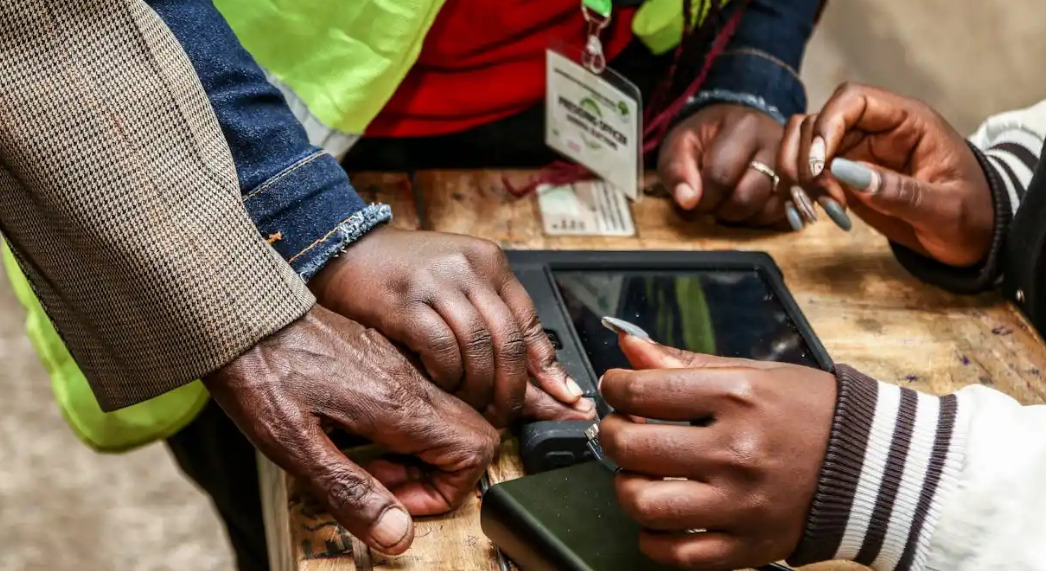
The rise of Artificial Intelligence (AI) technology in Africa, particularly within the ECCAS zone, has transformed electoral processes according to Tendai Mbanje. AI has transformed the electoral scene in Africa, significantly enhancing the quality of elections as reported by Samson Itodo in Supporting Democracy Worldwide. This transformation includes improvements in voter registration, candidate selection, political party manifestos, campaigns, and verification processes, among others. Specifically, AI technologies have demonstrated their effectiveness in voter registration and verification through biometric systems like facial recognition and fingerprint scanning, which are commonly utilized in African nations. This technology has proven to be effective in ensuring that only qualified voters can take part in the electoral process.
Additionally, AI has improved the analysis of electoral data and predictive analytics. For example, according Tendja Mbanje, AI can process large volumes of data to uncover patterns, trends, and possible irregularities in voter behavior, election campaigns, and results. Consequently, the implementation of AI can assist Electoral Management Bodies (EMBs) and election stakeholders in identifying and preventing electoral fraud or manipulation, along with other unethical practices. It is posited that AI-driven systems possess the ability to improve the security of electoral processes by identifying and mitigating cybersecurity threats, including hacking attempts on electoral systems and databases, as well as disinformation campaigns designed to sway or mislead voters. This fosters greater transparency and accountability within the electoral framework. Significantly, recent electoral patterns indicate a rise in voter engagement through the use of chatbots, mobile applications, and social media channels to disseminate information regarding candidates, election procedures, and polling sites. In Cameroon, the development of the VoteCam app has been very instrumental to assist citizens locate registration centres, know their candidates better, understand their profile and the agendas. In certain instances, this has led to an uptick in voter turnout and active participation in the electoral process as was the case in South Africa, Nigeria, Eswatini and Madagascar in Samson’s paper.
Conclusion and Recommendations
Recent trends suggest that AI has the potential to transform electoral processes in ECCAS; however, there are ongoing concerns regarding the ethical use of AI technologies and adherence to data privacy regulations, which are essential for maintaining the integrity of elections. When misused, AI can lead to issues such as disinformation, misinformation, and data privacy violations, potentially worsening existing disparities in access to information and resources. The proportion of African electoral commissions that have not adopted AI for elections is greater than those that have implemented AI systems.
Although AI could significantly affect elections in African, the conversation surrounding AI and elections is influenced by binary power dynamics, with Africa at a disadvantage due to its minimal ownership of the technological infrastructure necessary for AI systems. Africans do not own any of the major tech companies. It is imperative for Africa to establish a regulatory framework that prevents the misuse of AI, which could jeopardize election integrity, information accuracy, and democracy. There must be concerted efforts to ensure that African nations comprehend AI technology to enhance democratic and electoral processes.
The year 2024 was referred to as ‘the election superbowl’ because of the significant number of elections occurring worldwide, particularly in the United States and the European Union. In Africa, more than 20 countries conducted elections. A notable aspect of these elections was the heightened awareness regarding the implications of generative artificial intelligence (AI), which brings risks such as the dissemination of misinformation, disinformation, hate speech, and infringement of human rights according to The European Think Tanks Group (ETTG). The way Africa approaches AI in elections and its regulation is significantly shaped by global trends. Historically, both state and non-state entities have interfered in African elections, raising alarms about the possible effects of AI on upcoming elections. The African Union (AU) has expressed in its Continental AI Strategy that external influences from AI technologies created outside of Africa could jeopardize democratic sovereignty, the values of Pan-Africanism, and civil liberties. Therefore, to address some of the issues linked to AI in elections, the following recommendations are proposed.
- Promote voter education: Many voters lack knowledge about AI technologies, including deepfakes and various digital threats, making them susceptible to manipulation. To address this issue, Election Management Bodies (EMBs) ought to allocate resources towards voter education initiatives that clarify the role of AI in elections, tackling issues like data privacy, cybersecurity, and manipulation. This educational effort should emphasize strategies to reduce AI-related harms, such as recognizing deepfakes and combating disinformation. By informing the public on how to detect deepfakes, disinformation, and the ethical use of AI, we can safeguard the integrity of elections.
- Promote cooperation and knowledge sharing among EMBs: As AI represents a novel technology, it is beneficial for EMBs to collaborate and exchange insights on utilizing AI effectively, as well as strategies to address potential risks and challenges.
- It is crucial for electoral bodies to create frameworks for data governance and strategies for AI. Alongside guidelines for AI usage, every Election Management Bodies should formulate a data governance framework that explicitly details their data processing activities. A thorough data governance approach guarantees the quality, security, and privacy of data, all while adhering to data protection standards and ethical principles related to AI.
As stakeholders evaluate the incorporation of AI in African elections, it is essential to concentrate on the possible risks and advantages that AI systems pose for election integrity, voting rights, and the accuracy of information. Efforts must be aimed at ensuring that AI technology is not used to worsen democratic decline within the electoral process; instead, it should work to bolster electoral integrity.
Given the opportunities and challenges that AI presents, election authorities, observers, and other stakeholders need to adopt a value-driven strategy for the implementation of AI in elections, making sure that the threats to election integrity, voter rights, and democracy are minimized. This strategy should encompass a commitment to principles such as fairness, reliability, safety, privacy, transparency, and inclusivity in the design, deployment, and regulation of AI systems in African elections.
The recent enactment of the world’s most comprehensive AI regulation by the EU, along with the UN General Assembly resolution on AI, provides a framework for Africa to develop and enforce its own regulatory guidelines. Africa needs a regulatory framework to avert the misuse of AI that could jeopardize election integrity, information accuracy, and democratic processes. Moreover, electoral commissions and observers should enhance their knowledge base to better understand AI and keep up with its swift advancements.

Dr. Primus M. Tazanu
Dr Primus M. Tazanu is a Research Fellow in Governance at the Nkafu Policy Institute .He is equally a lecturer at the Department of Sociology and Anthropology, University of Buea, Cameroon. Primus holds a PhD in social anthropology from the University of Freiburg, Germany

Dr. Pippie Hugues
Dr. Pippie Hugues is a Policy Analyst at the Governance and Democracy Division of the Nkafu Policy Institute. He holds a Ph.D. in International Law with specialty in Human Rights, Conflict and Peace building.

