





















(Business in Cameroon) – Cameroon’s energy sector has seen significant expansion since 2018, driven by infrastructure projects reshaping the electricity landscape. However, the government’s target of raising generation capacity to 3,000 MW, originally set for 2025, has been pushed back to 2030 due to delays in implementation.
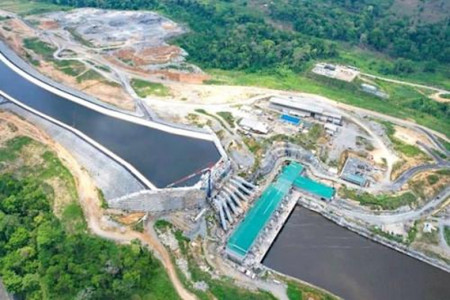
The Nachtigal hydroelectric dam is the centerpiece of Cameroon’s expansion. The 420 MW facility came online in June 2024 and reached full capacity in March 2025. Built under a public-private partnership with the state, EDF and the International Finance Corporation (IFC), the project represents more than XAF1.2 trillion in investment including associated transmission lines.
Nachtigal’s launch increased national capacity by about 30% and has already reduced the frequency of power outages. The project generated over 3,000 direct and indirect jobs, stimulating the economy in the Center region. New transmission lines linking the dam to the Southern Interconnected Grid are set for completion in the third quarter of 2025, aiming to secure power supply for major industrial hubs and reduce system losses.
The Lom Pangar regulating dam, commissioned prior to 2018, fully demonstrated its utility during the period. Its 6 billion cubic meter reservoir regulates the Sanaga River’s flow, providing an average of 120 MW of additional power to downstream plants. This has significantly improved production stability, particularly during the dry season.
Gas-fired thermal plants have also bolstered Cameroon’s power supply. The 216 MW Kribi plant, fueled by domestic gas, complements the 88 MW Dibamba facility, helping diversify the energy mix and reduce reliance on imports.
The 216 MW Kribi plant, fueled by domestic gas, complements the 88 MW Dibamba facility, helping diversify the energy mix and reduce reliance on imports.
In renewables, the 30 MW Guider solar plant, commissioned in 2023, is the country’s first large-scale solar facility. It supplies electricity to about 150,000 people in the North, helping ease regional disparities.
The Rural Electrification Program (PER), backed by XAF200 billion, connected around 400 localities between 2018 and 2023, bringing electricity to more than 1.5 million people. Authorities have yet to release consolidated data for 2024-2025, leaving the goal of 500 localities and 2 million beneficiaries uncertain.

Over 2,000 kilometers of power lines were constructed or rehabilitated, and substations equipped with modern transformers
The transmission infrastructure was also upgraded, with over 2,000 kilometers of power lines constructed or rehabilitated, and substations equipped with modern transformers to reduce technical losses. Solar mini-grids are expanding rapidly, with about 20 pilot installations already operating across the Adamaoua, North, and Far North regions. Additional projects are underway to increase this number to over a hundred, though the target has not been officially met.
Finally, institutions such as the National Advanced School of Engineering (ENSP) and the University Institute of Technology (IUT) adapted their curricula to meet the technical demands of the new infrastructure, but the exact number of specialists trained between 2018 and 2025 remains unconfirmed. The Electricity Sector Regulatory Agency (ARSEL) continued modernizing tariff regulation and service quality oversight. Meanwhile, Cameroon’s participation in the Central Africa Power Pool (PEAC) sets the stage for regional exchanges, although interconnections with Chad and the Central African Republic are pending finalization.

