





























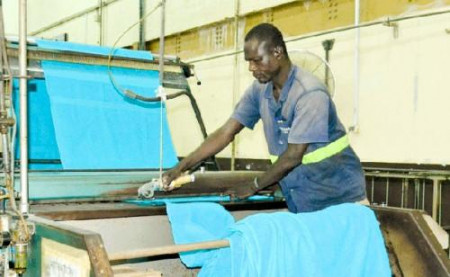
(Business in Cameroon) – In a bid to revive the state-owned textile company Cotonnière industrielle du Cameroun (Cicam), the Cameroonian government is negotiating to reserve a series of captive markets for domestic production, a move that would provide a stable revenue stream for the company.
As part of ongoing negotiations with Arise IIP for Cicam’s revival, the state plans to set aside key public contracts—primarily for school uniforms and hospital garments—for local production. A source close to the matter confirmed that these contracts, valued at 24 billion to 30 billion CFA francs per year, would also include uniforms for prison guards and police officers, though not for the army or gendarmerie. The government also intends to entrust the company with producing fabric for International Women’s Day on March 8.
Arise IIP’s stated goal is twofold: to modernize Cicam and to establish an integrated textile supply chain that covers the entire value chain, from raw cotton production to final garment manufacturing. The plan would rely on a partnership with the cotton company Sodecoton for raw material supply and on Cicam for processing and distribution. This entry by Arise into Cicam’s capital could help the company, once a textile giant in the CEMAC zone, emerge from years of decline.
To achieve this, Arise plans a 200 billion CFA franc investment to modernize factories, install new production lines, and recapitalize the company. The objective is to make Cicam competitive against increasingly aggressive foreign competition.
Today, Cicam holds only about 5% of the national cotton-textile-garment market, largely undermined by Chinese imports and the booming secondhand clothing market. In 2023, Cameroon imported 61,221 tons of used clothing worth 30.2 billion CFA francs, accounting for nearly 35% of all secondhand clothing imports in the CEMAC zone. China alone controls nearly 80% of the Cameroonian textile and clothing market, intensifying pressure on local producers.
To reverse the trend, Cicam would leverage Arise IIP’s expertise and capital, as well as state support through guaranteed domestic markets and a proactive policy to promote local processing.
This revival aligns with the government’s 2020-2030 National Development Strategy (SND30), which aims to structurally transform the Cameroonian economy. The strategy targets an annual cotton production of 600,000 tons and a local processing rate of 50% by 2030 to strengthen the textile sector and generate more added value.
Amina Malloum

