























Cameroon’s Directorate General of Customs and the African Regional Centre for Endogenous and Community Development (CRADEC) are exploring reforms aimed at tightening controls on financial flows and strengthening state revenue mobilization as preparations advance for the 2027 Finance Law.
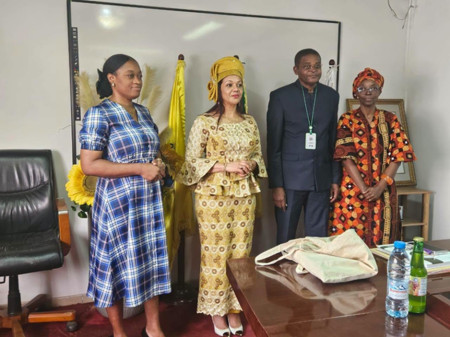
The proposals include linking taxpayer databases across key public institutions, improving disclosure of the real owners of companies and strengthening cross-border controls in sectors considered vulnerable to illicit financial flows. The measures were discussed during an audience granted to CRADEC Executive Director Jean Mballa Mballa on August 19 by Hélène Elise Etaba Bikoun, head of Customs’ Revenue Collection and Statistics Division, who represented the Director General of Customs, according to information published by the Directorate General of Customs.
The discussions come as the government prepares its fiscal framework for 2027, with domestic revenue mobilization and efforts to curb financial leakages among the issues under consideration. CRADEC has proposed the creation of a single national taxpayer database through the interconnection of Customs records with databases managed by the Directorate General of Taxation (DGI), the National Social Insurance Fund (CNPS) and the Single Window for Foreign Trade Operations (GUCE).
Such an arrangement would bring information held by several public institutions into an interconnected framework for taxpayer identification and monitoring.
The second proposal concerns beneficial ownership transparency. CRADEC wants Customs to contribute to the National Register of Beneficial Owners alongside the DGI and the National Agency for Financial Investigation (ANIF). The mechanism is intended to identify the individuals who ultimately own or control companies, including those operating through complex corporate structures.
Extractive, forestry sectors under focus
The third proposal targets cross-border financial flows. CRADEC is seeking stronger Customs controls, with particular attention to the extractive and forestry sectors, which the organisation considers particularly exposed to illicit financial-flow risks.
Customs and CRADEC are expected to continue discussions to assess the technical feasibility of the proposals. According to the Customs administration, the process could also lay the groundwork for longer-term cooperation aimed at maximising state revenue.
The August 19 meeting follows a high-level roundtable organized by CRADEC on June 25 with parliamentarians from the African Parliamentary Network on Illicit Financial Flows and Taxation (APNIFFT). The meeting produced consolidated budget policy recommendations covering tax justice, transparency, gender-sensitive taxation and measures against illicit financial flows.
The revenue stakes extend beyond Cameroon. An earlier Business in Cameroon report, citing figures presented by Cameroon’s Minister Delegate to the Minister of Finance, Yaouba Abdoulaye, reported that Africa loses more than $89 billion annually through illicit financial flows. The figure, widely cited by the African Union, originates from estimates by the United Nations Conference on Trade and Development (UNCTAD).
Abdoulaye said these resources escape national economies and reduce governments’ capacity to finance development priorities.
The same report said illicit financial flows can reduce tax revenues and domestic resource mobilization while limiting resources available for sectors such as infrastructure, health and education.
CRADEC, founded in Cameroon in 1996, works on tax justice, transparency in the management of extractive and public resources, and efforts to combat tax fraud, tax evasion and illicit financial flows.
Mercy Fosoh

