
















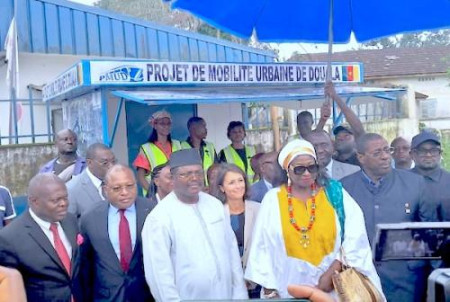
The Douala Urban Mobility Project (PMUD) needs an additional 104.6 billion CFA francs to maintain its current scope, including 66 kilometers of additional feeder roads planned around the pilot Bus Rapid Transit (BRT) corridor.
As of July 17, 2026, the cost of completing the project was estimated at 365.4 billion CFA francs including taxes, compared with an initial budget of 260.8 billion CFA francs. The financing gap is therefore equivalent to 40.1% of the original budget.
Without new funding or tax relief, the shortfall could lead to a downsizing of the BRT during a restructuring review scheduled with the World Bank for late September 2026. The scenario now under consideration would replace the initially planned “heavy” system with lighter infrastructure that would cost less but also deliver lower performance.
Feeder roads drive up the cost
Most of the cost overrun comes from the addition of 66 kilometers of feeder roads intended to better connect Douala neighborhoods to the main corridor. Their construction would bring the total length of these roads around the BRT to about 80 kilometers.
In correspondence dated July 13, 2026, the Finance Ministry used a tax-exclusive cost base of 226 billion CFA francs when the additional works were excluded. Including them raises the estimate to 306.4 billion CFA francs before taxes, an arithmetic increase of 80.4 billion CFA francs, or 35.6%, on a comparable basis.
About 58.9 billion CFA francs in value-added tax is added to that amount, bringing the rounded total cost to 365.4 billion CFA francs including taxes, according to the project document reviewed by Business in Cameroon.
Tax relief could eliminate half of the shortfall
To reduce the financing requirement, the PMUD steering committee, chaired by the mayor of Douala, is seeking tailored tax treatment. The Douala City Council had already asked the Finance Ministry for exemptions in December 2024. Discussions later involved the Economy Ministry, the World Bank and the tax and customs administrations.
As of July 27, 2026, no final decision had been made. The General Directorate of Taxes was still awaiting feedback from the Economy Ministry. The General Directorate of Customs still had to examine several mechanisms, including framework letters, direct clearance and temporary admission, while the Finance Ministry had to assess their compatibility with existing financing agreements.
Under the scenario backed by the steering committee, carrying out the project on a tax-exclusive basis would reduce the shortfall by about 54 billion CFA francs, slightly more than half of the current financing need. The remaining gap, close to 50 billion CFA francs, would then be the subject of a request for additional financing from the World Bank.
That option would not reduce the technical cost of the infrastructure. It would lower the project’s cash financing requirement by shifting part of the burden to the state through tax revenue it would forgo. The net budgetary impact of such tax treatment is not specified in the documents reviewed.
A lighter BRT option gains ground
On July 28, 2026, the World Bank proposed examining a lighter version of the BRT. The financing shortfall is not the only factor cited. Some sites intended for operations and maintenance centers have not yet been secured, while the project is scheduled to close on June 16, 2028.
A light BRT would reduce the initial investment and speed up commissioning. In return, its transport capacity would be lower and its commercial speed would range from 18 to 25 kilometers per hour, according to the project document. The heavy system, by contrast, could reach an average speed of 35 kilometers per hour and handle significantly higher demand.
A change in technology would therefore require a revision of both the project’s physical scope and its operating objectives. Targets of 535,000 passengers per day and 251 buses, which remain included in the implementation report published by the World Bank in March 2026, would have to be recalibrated.
The economics of the public-private partnership planned to finance the fleet and operate and maintain the BRT would also have to be reassessed because they depend in part on ridership, fleet size and expected revenue.
A project already under schedule pressure
The PMUD was approved on June 2, 2022, at a total cost of $540 million, including $420 million provided by the International Bank for Reconstruction and Development and the International Development Association. The initial financing structure also anticipated $100 million in private participation for rolling stock and $20 million in counterpart funding for resettlement, according to a World Bank aide-memoire published in 2022.
Even before the July financial update, the World Bank rated both progress toward the development objective and overall project implementation as “moderately unsatisfactory” as of March 3, 2026. Overall risk was rated “high,” and the institution flagged delays that could affect the implementation schedule.
The tax relief requested by the Douala City Council would therefore address only part of the financing problem. Even under that scenario, nearly 50 billion CFA francs would still have to be financed.
The review scheduled for September will have to weigh additional resource mobilization, a reduction in feeder-road works and abandonment of the heavy-format BRT. That choice will determine not only the project’s cost but also the capacity, commercial speed and economic model of Douala’s future mass transit network.
Ludovic Amara

