




























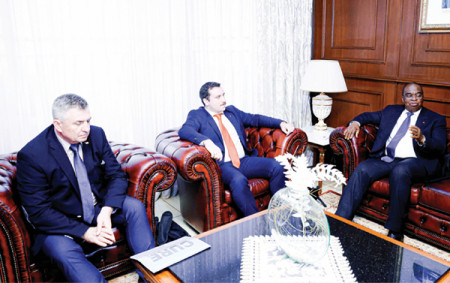
Ukraine has offered to share its experience in modern agriculture with Cameroon as the two countries seek to expand economic and commercial cooperation.
The proposal was discussed during a meeting between Finance Minister Louis Paul Motaze and a Ukrainian delegation in Yaounde on August 5. The delegation was led by Davyd Hohiia, Second Secretary for Economic Affairs at the Embassy of Ukraine in Nigeria.
According to Cameroon’s Ministry of Finance, discussions focused on agricultural financing mechanisms, experience sharing and opportunities for cooperation aimed at strengthening the resilience and modernization of Cameroon’s agricultural sector.
Hohiia said Ukraine was seeking to develop economic and commercial cooperation with Cameroon across several sectors.
“We discussed the different ways through which we can establish cooperation between our two countries. Ukraine has a lot to share with Cameroonians, and we are ready to cooperate with everyone,” Hohiia said.
Beyond agriculture, the Ukrainian delegation also proposed sharing technical and technological experience in public finance, particularly in the mobilization and securing of fiscal and customs revenues.
Cameroon pushes for greater agricultural resilience
The proposed cooperation comes as Cameroon seeks to strengthen domestic agricultural production and reduce its exposure to international commodity and supply shocks.
That vulnerability became particularly visible following the outbreak of the Russia-Ukraine war in 2022, when disruptions to global grain supplies affected wheat imports and domestic food prices.
Cameroon imported 920,400 tons of wheat worth CFAF260.7 billion in 2022, according to National Institute of Statistics, INS, data reported by Business in Cameroon. The volume was down 4.8% from 966,400 tons in 2021.
Russia’s contribution to Cameroon’s wheat imports fell sharply, from 524,000 tons in 2021 to 138,000 tons in 2022, as international supply chains came under pressure.
The disruption was also reflected in domestic prices. In March 2022, the authorized price of a 50kg bag of wheat flour increased from CFAF19,000 to CFAF24,000, while the official price of a 200-gram loaf of bread rose from CFAF125 to CFAF150, Business in Cameroon reported.
INS later reported that bread and cereal prices increased by 16.3% in 2022. Overall food prices rose by 12.9%, contributing to national inflation of 6.3% that year.
Agriculture accounts for about 20% of Cameroon’s GDP and employs more than 60% of the active population, according to World Bank estimates cited by Business in Cameroon.
The government is seeking to expand production through its 2024-2026 Integrated Agro-pastoral and Fisheries Import-Substitution Plan, PIISAH. The program is designed to increase local production and processing while reducing dependence on food imports.
Business in Cameroon reports that the plan targets products including rice, maize, fish and other major food commodities.
For the 2026 agricultural season, authorities have set a target of 400,000 tons of rice and an additional 40,000 tons of palm oil, alongside increased mechanization and the distribution of improved seeds and processing equipment.
Ukraine draws on major agricultural industry
Ukraine’s proposal is backed by the experience of one of Europe’s major agricultural producers and exporters.
The country harvested 57.6 million tons of grain and 17.3 million tons of oilseeds in 2025, according to Ukraine’s Ministry of Economy, Environment and Agriculture.
Ukrainian agricultural exports reached $22.6 billion in 2025 and represented about 56% of the country’s total exports. Cereal exports alone were valued at $7.27 billion, including $3.90 billion from maize and $2.99 billion from wheat and meslin.
The discussions in Yaounde therefore center on transferring experience from an economy where agriculture remains an important source of export earnings, while Cameroon is seeking to increase productivity, strengthen local processing and reduce food import dependence.
The Finance Ministry said Motaze reaffirmed the government’s commitment to supporting the transformation of Cameroon’s agricultural sector, which authorities view as a key driver of economic growth, employment and food security.
Mercy Fosoh

