






















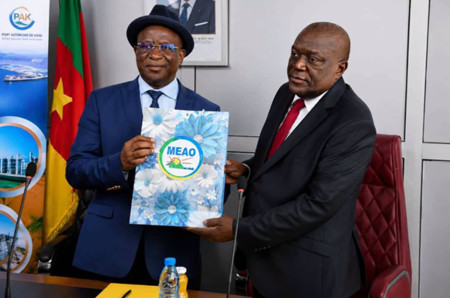
The Port Authority of Kibi, PAK, and the Mission for the Study and Development of the Ocean Department, MEAO, have signed a three-year renewable framework agreement aimed at coordinating the territorial development of the Ocean Division as industrial activity around the Kribi port complex accelerates. The agreement was signed on July 13, 2026 and seeks to align infrastructure planning, public services and economic development with the expected expansion of industries linked to the deep-sea port.
The partnership comes as the industrial zone developing around Kribi is expected to generate at least 30,000 direct jobs and a similar number of indirect jobs over the next five years. According to the two institutions, the anticipated increase in economic activity is expected to drive population growth and increase demand for housing, urban infrastructure, water, energy and other social services across the department. The agreement also provides for joint support for major development projects, the promotion of collaborative governance, the preservation of natural resources and the development of the blue economy.
PAK Director General Patrice Melom said the agreement responds to the scale of economic changes taking place around the port and the need to ensure that territorial planning keeps pace with industrial growth.
“The Port of Kribi confirms day after day its role as an economic catalyst in this region. We believe this growth must be planned,” Melom said.
Speaking on the expected impact of the industrial zone, Melom noted that thousands of direct and indirect jobs are projected over the coming years, creating new pressures on public services and infrastructure.
“It is therefore the responsibility of the State, and particularly institutions such as the MEAO, to plan this development. We want to work together within this agreement not only to plan it but also to implement the structuring projects aimed at improving the living conditions of local populations,” he added.
The agreement formalizes a collaboration that both institutions say has existed for years and is intended to move from planning to implementation.
Focus on infrastructure, population needs and industrial development
MEAO Director General Mbouh Nzibi Louis Mathieu said the partnership marks a new phase in the institution’s mission of guiding sustainable territorial development in the Ocean coastal zone. Created in 1999, the MEAO is responsible for designing, coordinating and conducting studies linked to the development and planning of the department’s coastal area.
According to Mbouh Nzibi, one of the principal challenges is ensuring that improvements in living conditions keep pace with the rapid implementation of large-scale infrastructure projects.
He said infrastructure investments have advanced significantly while some local communities continue to face development gaps, creating a need for coordinated planning and targeted support projects.
“With the cooperation of the Director General of the Port Authority of Kribi, we will develop strategic plans to successfully carry out development. We want to avoid a two-speed development model in the department,” he said.
Under the agreement, the two organizations will establish a Strategic Coordination Committee and a Joint Operational Committee to oversee implementation. The partnership will also support technical studies, planning tools and development initiatives designed to accompany industrial growth.
Both parties said the partnership is intended to strengthen coordination between economic development projects and local communities as Ocean Division prepares for the demographic and economic changes expected to accompany the continued expansion of the Kribi port and industrial zone.
Mercy Fosoh

