












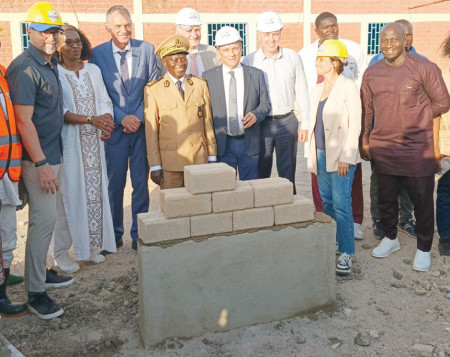
Six European ambassadors have completed a five-day mission across the North and Far North regions, visiting development projects, refugee camps, universities and local communities. The field tour was aimed at assessing the impact of cooperation programmes financed by the European Union, EU, and its member States.
The diplomatic mission began in Maroua, where the six heads of mission met Far North Governor Midjiyawa Bakari before setting off to inspect projects across Maroua, Mora, Minawao and Garoua. The delegation was led by the Head of Delegation of the European Union to Cameroon, H.E. Jean-Marc Châtaigner, and included the ambassadors of Germany, Belgium, Spain, France and Italy.
According to stakeholders, the visit was designed to enable the diplomats directly evaluate projects implemented in the northern regions and engage with local authorities, traditional rulers, students, entrepreneurs, refugees and civil society representatives.
Belgian Ambassador Alain Leroy said the delegation had chosen to engage directly with local populations to better understand the realities on the ground and assess the outcomes of projects financed in the region.
“The region continues to face major climatic, economic and humanitarian challenges, and our presence reflects the importance attached to supporting these communities,” he said.
In the Mayo-Sava Division, the diplomats visited labour-intensive public works carried out under the RESILAC 2 programme, where young people are paid to develop agricultural access roads.
H.E. Jean-Marc Châtaigner recounted being struck by the testimony of one young worker who described saving part of his earnings to finance his own future project.
“One young worker told us he was setting aside 1,250 CFA francs to prepare his own initiative. It is a simple statement, but it symbolises hope. It demonstrates the determination of young people to build opportunities for themselves despite the challenges they face,” Châtaigner stated.
At Minawao refugee camp, the delegation observed income-generating initiatives led by Nigerian refugee women, including a community restaurant, tailoring, fish farming and agricultural activities. The projects are intended to support economic autonomy alongside humanitarian assistance.
In Maroua, the ambassadors also visited urban infrastructure financed by the French Development Agency, including a 1,000-seat multi-purpose hall. French Ambassador Sylvain Riquier said such investments were designed to support long-term urban transformation and strengthen local government capacity.
“The objective is to transform the city sustainably through infrastructure that serves communities while also reinforcing the financial resources of local authorities. These facilities are intended to have a lasting impact,” he said.
The mission also included a cultural dimension during a reception at the palace of the Lamido of Maroua, where H.E. Châtaigner was elevated to the rank of Wakili Ahmar, or high representative of the Lamido for European affairs.
Châtaigner explained that the distinction was symbolic, adding that it reflected a shared commitment to peace and dialogue.
“It is a message of peace and dialogue between cultures. It also symbolises a common commitment in the fight against extremism,” he said.
The tour ended in Garoua with discussions at the University of Garoua, where the ambassadors urged greater cooperation and encouraged students to consider opportunities in the country’s northern regions.
Mercy Fosoh

